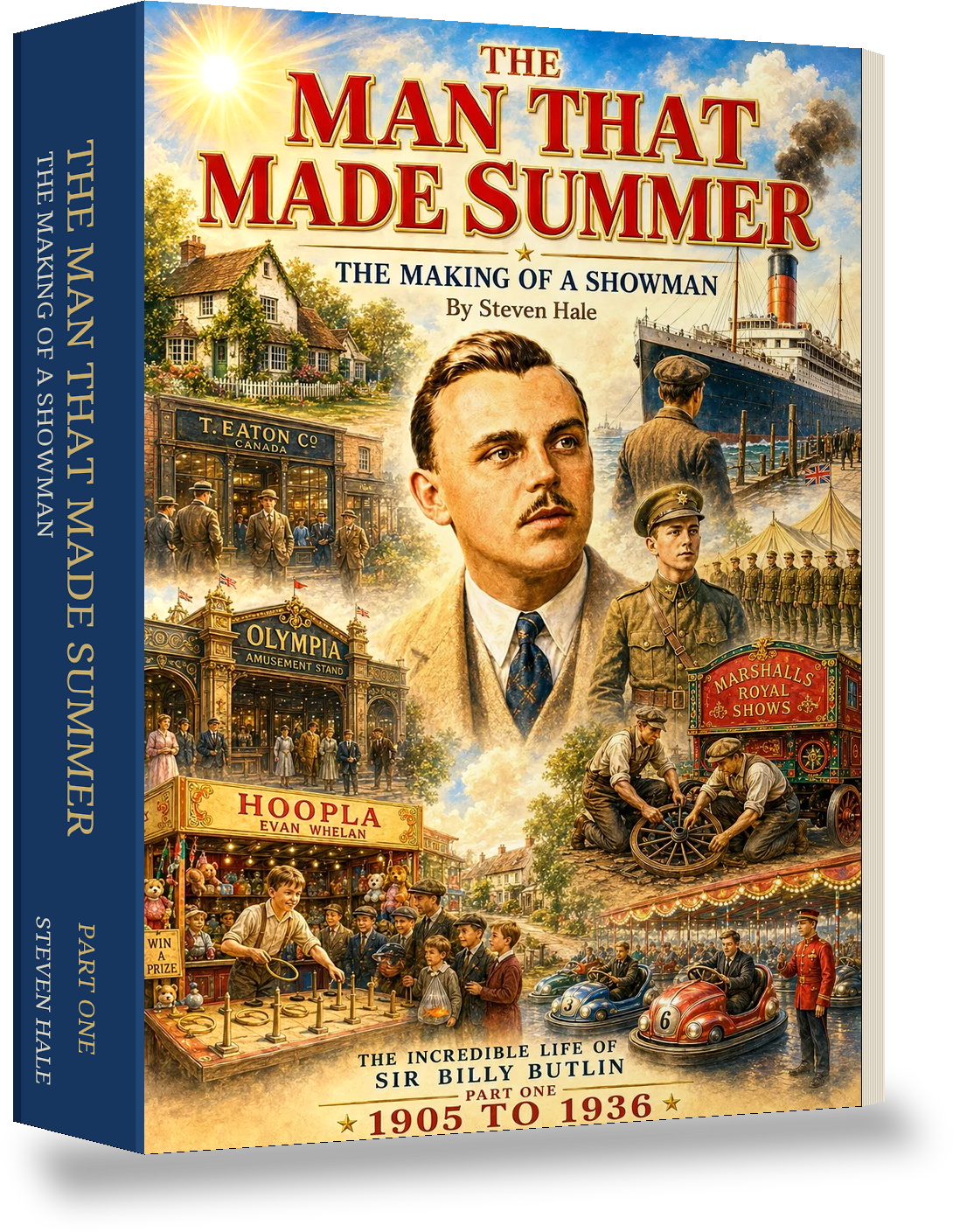
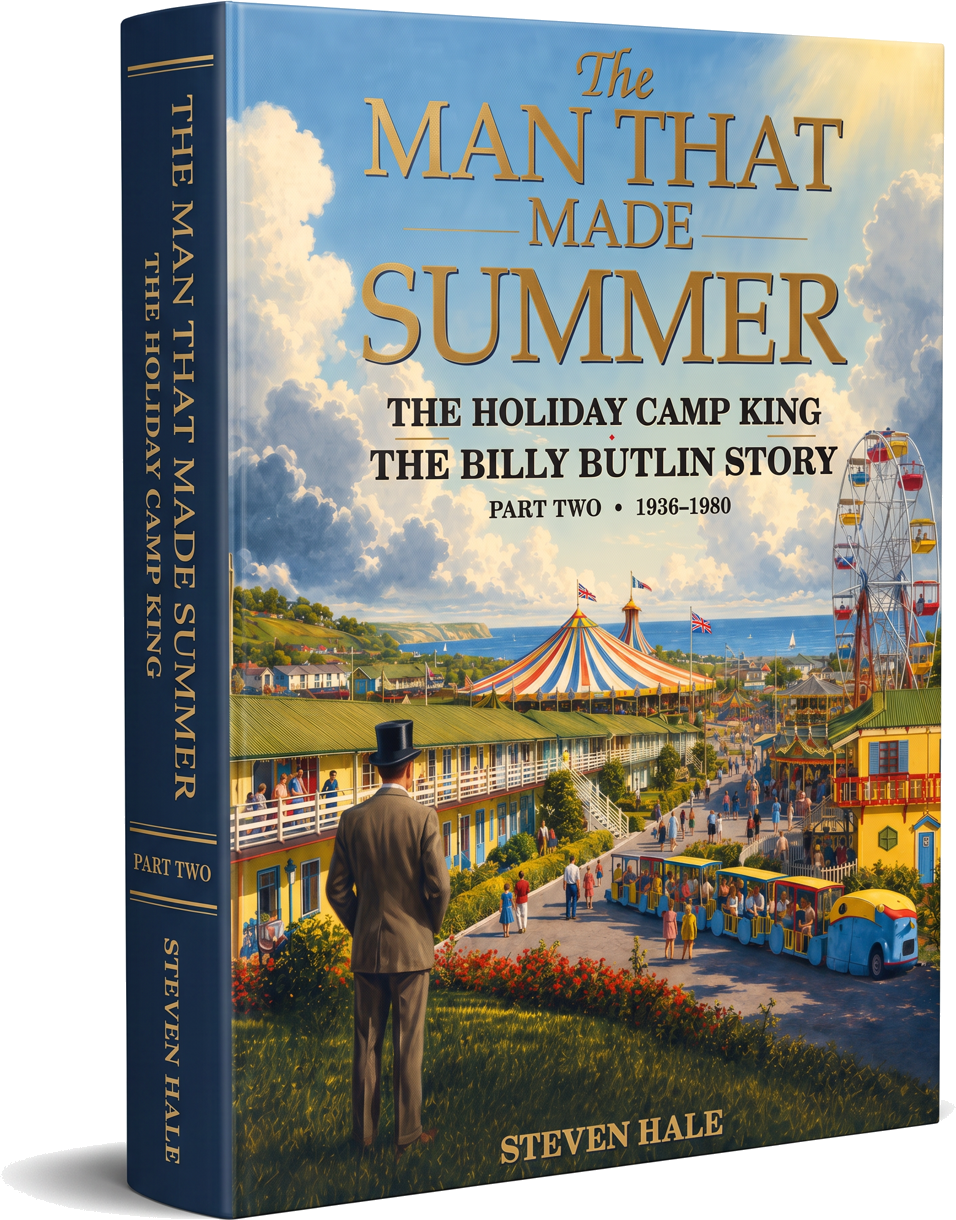
The Man That Made Summer · The incredible life of Sir Billy Butlin · By Steven Hale
Some men build companies. Billy Butlin built a British summer.
A fairground childhood — 1899 to the 1900s
Billy Butlin was born in 1899 in South Africa, into a family whose living came from the travelling fairground. The road was his first home. He grew up around stalls, rides, engines and the noise of a crowd deciding where to spend its next penny. When the family moved to England he was still a boy, and not long after they crossed the Atlantic again to Canada. He never stayed in one school long enough to be missed when he left. What he learned instead, he learned on the ground: how a crowd moves, what makes a person reach into a pocket, and how much a family will give for one good day out.
Canada, Eaton's and the Great War
In Toronto he worked for the Eaton's department store, a vast, disciplined operation that taught him how a large business runs. Then the war came. He returned across the Atlantic to serve in the Great War, and when it was over he came back to England with almost nothing to his name: a few pounds, an eye for a pitch, and a willingness to work harder than the man beside him.
The hoopla stall and the travelling fairs
He started with a hoopla stall. A wooden counter, rings, prizes and a patter. Most operators rigged the game so nobody won. Billy widened the rings so people did. The crowds came to him, and that one decision — giving the punter a fair chance and a good time — became the seed of everything that followed. From the stall he moved into rides and then into amusement parks. He took pitches at Olympia in London and along the seaside towns, building his own fairgrounds and learning the business from the ground up.
The question that would not go away
All those years on the road gave him a question he could not shake. A working family saved all year for a week at the seaside, paid a boarding house, and was turned out after breakfast into the rain. There had to be a better way to give ordinary people a holiday.
Skegness, 1936
In April 1936 he answered it. He opened the gates at Skegness with a promise printed above them — Our true intent is all for your delight — and a week's holiday for a week's wage. For that price a family got a chalet, three meals a day, entertainment, swimming, sport and something to do from morning until night. Britain had never seen anything like it.
After Skegness came Clacton, Filey, Pwllheli, Ayr, Bognor, Minehead and Barry Island. During the Second World War the camps became naval and army bases. Afterwards came the holiday camp boom: the Redcoats, the ballrooms, the boating lakes, the monorails, and eventually a knighthood for the man who had changed how a whole country took its summer.
The rest of the story
He lived to see his name become part of British life. He died in 1980, but the holidays he invented are still in the blood of millions of families.
Two volumes. One extraordinary life. And in all likelihood, somewhere in it, a week of your own family’s history.
Share yours — the archive is open.
Upload a Photo for Cover and Sleeve